
Showcase category ➤ Recreating Freshwater Ecosystems
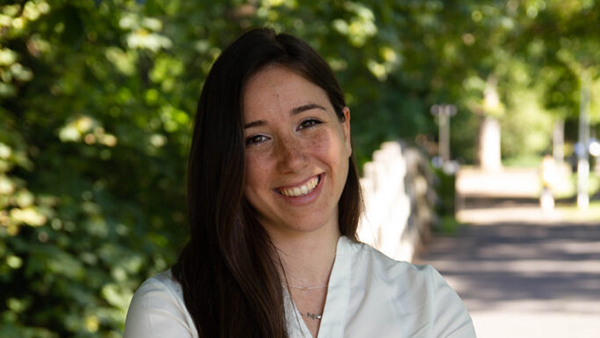
Borjana Bogatinoska
Postdoctoral Researcher - University of Twente
Scientists & Researchers
My Projects
 Co-Adapt (Interreg 2 Seas)
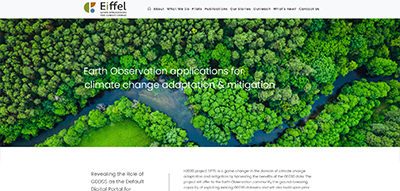 EIFFEL (Horizon2020)
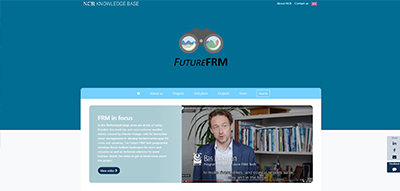 Future FRM Tech (NWO)
- Key project facts
Co-Adapt had the focus on climate adaptation and mitigation NbS measures by active involvement of all stakeholders in the area
EIFFEL had the focus on using earth observation (GEOSS) data for climate adaptation and mitigation
FutureFRMtech has the focus of developing innovative technologies for flood risk reduction in riverine and coastal areas in the Netherlands through 3 case studies.
- What impact did these projects have on biodiversity, if any?
Biodiversity was not the main driver in these projects as they were mainly focused on flooding and drought. But the idea is that with the implemented NbS, as a multifunctional solution that inspires the development of natural processes, there will be positive benefits on the biodiversity as well.
- What work challenges did you face and what approach did you take to solve them?
The biggest challenge within Co-Adapt project which had co-creation with stakeholders as one of the main goals was the COVID19 crises. People just didn’t feel the climate urgency in times where health was a priority. Additionally it was also extremely difficult to engage stakeholders when face to face meetings were not possible. What was amazing to see is how many innovative online tools were designed for stakeholders to first learn about the urgency of climate change and its effects, and then to also engage with them on designing necessary NbS measures. The toolkit of these online and in person methods for engaging with stakeholders developed in the Co-Adapt project is available in this publication: https://doi.org/10.3390/su14095562
- What lessons learned are transferable to other places/projects?
- Stakeholder Co-Creation
- Early and active involvement of local stakeholders improves solution acceptance.
- Use structured participation frameworks (e.g. Ladder of Participation).
- Acknowledge power dynamics and ensure genuine empowerment.
- Knowledge Exchange
- Cross-catchment practitioner exchanges are valuable for shared learning.
- Structured frameworks can enhance and systematize knowledge sharing.
- Participatory Tools
- Use a framework to select tools based on context, problem type, and stakeholder group.
- Match tools to local data availability and institutional settings.
- Integrated Modelling
- Combine disciplinary models (hydrological, carbon, erosion) when multifunctionality needs to be assessed.
- Keep models as simple as possible to balance technical accuracy and stakeholder usability.
- Use models as communication tools to support stakeholder dialogue.
- Socio-Ecological System Approach
- Frame catchments as socio-ecological systems to integrate biophysical and social aspects.
- This helps align NbS with both environmental functions and societal needs.
- Mixed-Methods Research
- Combine quantitative (modelling) and qualitative (interviews, workshops) methods for a comprehensive understanding.
- Scenario Modelling
- Use models to explore “what-if” scenarios in stakeholder discussions before implementation.
- Use models to explore “what-if” scenarios in stakeholder discussions before implementation.
- Stakeholder Co-Creation
- What was your technical biggest barrier and what did do about it?
The biggest technical barrier I faced was integrating disciplinary models — particularly hydrological and carbon models — into one coherent framework that could assess the multifunctionality of nature-based solutions. Each model had its own structure, data needs, and complexity, making full integration both technically challenging and resource intensive. To overcome this, I adopted a pragmatic integration approach where I used well-established, validated standalone models and connected them through carefully designed input-output linkages, rather than fully merging them into one complex system. This allowed me to maintain scientific rigor while ensuring the models remained transparent and understandable for stakeholder discussions, ultimately supporting both robust analysis and participatory decision-making.
My Focus and Approach
- Lessons Learnt - Some recommendations for others?
- What’s most important:
to ensure early and meaningful involvement of stakeholders combined with a clear integration of technical models that remain understandable and usable for both scientists and local actors.
- Do this, not that:
Do: Start with clear objectives, build trust with stakeholders, and use models to support joint learning. Not: Don’t design solutions in isolation or assume that complex models automatically lead to better decisions
- Always start by:
Always start by understanding the local context — both the physical landscape functions and the stakeholders' needs, values, and knowledge.
- What to do when things get difficult…:
When things get difficult, break the problem into smaller parts, simplify the modelling approach, focus on key functions, and keep open communication with stakeholders to maintain engagement and trust.
- 5 simple steps to:
- Map landscape functions: Identify key challenges (e.g. flooding, drought, carbon sequestration).
- Engage stakeholders: Organize early workshops and interviews to collect local knowledge.
- Select appropriate models: Choose validated hydrological and carbon models suitable for the catchment.
- Integrate models pragmatically: Link models via input-output relations rather than full integration if complexity is high.
- Use models in discussions: Visualize scenarios for stakeholders to support co-design and adaptive management.
- The biggest barrier and what I am trying to do about it:
The biggest barrier was integrating complex disciplinary models into a single usable system without overwhelming stakeholders. To address this, I focused on pragmatic, modular integration — connecting models where needed, keeping them as simple as possible, and ensuring they serve as effective tools for stakeholder discussions rather than purely technical exercises.
- What’s most important:
My Journey
- My journey:
My journey toward this PhD began with my background in civil and water engineering in North Macedonia, where I was originally trained to design traditional, rigid infrastructures. However, during my MSc internship in Delft, my perspective shifted as I became increasingly drawn to the challenges of climate change and the potential of nature-based solutions. This turning point inspired me to pursue a greener, more integrated approach to engineering that combines technical knowledge with social engagement. Eventually, I found an opportunity to explore these interests through a PhD on climate adaptation pathways and co-creating nature-based solutions, allowing me to merge my passion for modelling with participatory approaches to create more resilient, sustainable landscapes.
- My Education:
- BSc in Civil Engineering
- MSc in Water Engineering and Management
- PhD in Environmental Science
- The Big Change:
Seeing a bigger shift from top down to bottom up policies and active involvement of stakeholders in every phase of the project.
- Favourite part of the work I do:
Being in the field and looking at implemented and effective NbS measures. Teaching the next generations about more sustainable and inclusive measures aimed at multiple objectives.
Interview
Key Topics:
Key Topics
These relate to specific topics (e.g. technical solutions; restoration activities etc.) addressed within the showcase materials.
- Nature-based solutions
- Climate adaptation and mitigation
- Stakeholder Participation
- Integrated Environmental Modelling
- Flood resilience
- Carbon sequestration
Prone2Success Factors Demonstrated:
Prone2Success Factors Demonstrated
These are the Prone2Success checklist factors which are highlighted within this showcase. More information on the Prone2Success checklist can be found here.
- Measurable goals to improve ecosystem services
- Supports WFD, NRL and other restoration policy goals
- Communicate/engage with stakeholders from the outset
- Engage with the local community from the outset
- Obtain sufficient finance for all project stages
- Restoration works (design) are self-sustaining
- Local planning processes are transparent / clearly understood
- Include long term monitoring
- Include adaptive management approaches (combined with monitoring)
- Ensure stakeholder understanding / education of restoration goals & benefits
- Demonstrate specific ecological improvements/legal compliance / communicating results during and after the project
- Take climate change into account
NRL Restoration Categories:
NRL Restoration Categories
These are the restoration categories (listed under Annex VII of the European Nature Restoration Law (NRL) which are relevant to this showcase.
- [2] Improve hydrological conditions
- [5] Re-establish river meandering
- [6] Remove obsolete barriers
- [7] Re-naturalise river beds
- [8] Restore natural sedimentation
- [9] Establish riparian buffers
- [22] Improve connectivity across habitats
- [24] Remove / control invasive species
- [26] Restore fish spawning / nursery areas
- [32] Reduce pollution (chemicals, urban/industrial wastewater, litter, plastics)
Was this information useful?
Yes
No
No
Thank you for submitting feedback.
Click here to share your thoughts
Resources
Articles
- https://doi.org/10.1016/j.envsoft.2015.11.016 this one really inspired me to look into not only stakeholder integration in modelling but also the integration of different disciplinary models so that they can communicate effectively and communicate with stakeholders the multiple benefits of NbS.
- This resulted in my own paper: https://doi.org/10.1016/j.envsoft.2024.106116
- Another important and core paper is http://dx.doi.org/10.5751/ES-05551-180426 on socio-ecological systems. This also influenced my work on looking at catchments as socio ecological systems where practitioners use tools to co-develop NbS with stakeholders (https://doi.org/10.3390/su14095562), but also looking at how knowledge can be exchanged between practitioners from different catchments (https://doi.org/10.1080/26395916.2024.2415305).
Videos
In the following video you can see conversations with stakeholders after a participation event where they designed the area using a so called ‘landscape mapping’ tool. Bewoners uit Beerse ontwerpen overstromingsgebied aan de Laakbeek
Presentations
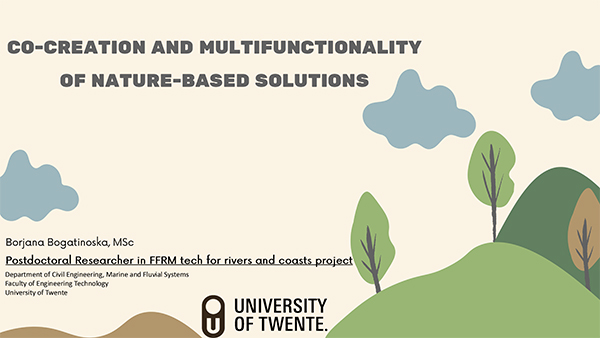 CO-CREATION AND MULTIFUNCTIONALITY
OF NATURE-BASED SOLUTIONS
Peer reviewed papers
- https://doi.org/10.1016/j.envsoft.2024.106116
- https://doi.org/10.3390/su14095562
- https://doi.org/10.1080/26395916.2024.2415305